Part 2 in the "How to Make an Ambient Light Monitor" Series. Our smart ambient light monitor will need to digitize and analyze signals from an optical detector,…
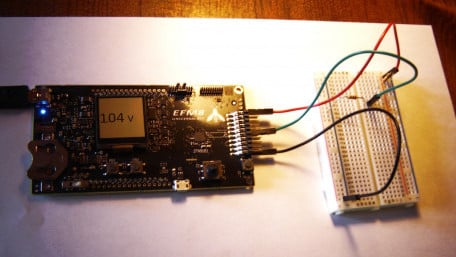
Part 2 in the "How to Make an Ambient Light Monitor" Series. Our smart ambient light monitor will need to digitize and analyze signals from an optical detector, so it is time to explore the EFM8’s integrated analog-to-digital conversion functionality.

Part 3 in the “How to Make an Ambient Light Monitor” series. The project continues by building an ambient light…
Part 3 in the “How to Make an Ambient Light Monitor” series. The project continues by building an ambient light sensor circuit on a breadboard, digitizing the circuit’s output signals, and interpreting the digitized measurements.

Multiplexing was developed in the early 1870s, but it’s become much more applicable to digital telecommunications in…
Multiplexing was developed in the early 1870s, but it’s become much more applicable to digital telecommunications in the late 20th century. Today, frequency division multiplexing (FDM), time division multiplexing (TDM), and wavelength division multiplexing (WDM) have become an extremely important asset to telecommunication processes and has greatly improved the way that we transmit and receive independent signals over AM and FM radio, telephone lines, and optical fibers.

Learn how to use an EFM8 microcontroller to convert current and voltage measurements to digits that can be displayed on…
Learn how to use an EFM8 microcontroller to convert current and voltage measurements to digits that can be displayed on an LCD. We'll discuss a convenient way to report analog-to-digital conversion values that represent current and voltage amplitudes.

Introduction to the Arduino SPI Library with example sketch for the LTC1286 12 Bit ADC and the DAC714 16 bit DAC.
Introduction to the Arduino SPI Library with example sketch for the LTC1286 12 Bit ADC and the DAC714 16 bit DAC.

New tunable capacitors from STMicroelectronics are meant to optimize signal-power transfer between a smartphone's antenna…
New tunable capacitors from STMicroelectronics are meant to optimize signal-power transfer between a smartphone's antenna and power amplifier. Other improvements include lower parasitic resistance and inductance, which boost efficiency and reduce heat dissipation, and a higher ESD rating for greater robustness.

The LM35 is an ideal temperature sensor for measuring ambient temperature. It provides a linear output proportional to…
The LM35 is an ideal temperature sensor for measuring ambient temperature. It provides a linear output proportional to the temperature, with 0 V corresponding to 0 degrees C and an output voltage change of 10 mV for each degree C change. LM35s are easier to use than thermistors and thermocouples because they are so linear and require no signal conditioning.

The Arduino can input and output analog signals as well as digital signals.
The Arduino can input and output analog signals as well as digital signals.

Communicating serially with the Arduino is easy! Here, we'll show how to take some temperature measurements and then send…
Communicating serially with the Arduino is easy! Here, we'll show how to take some temperature measurements and then send the measurements over the serial link.


 Facebook
 Google
 GitHub
 Linkedin