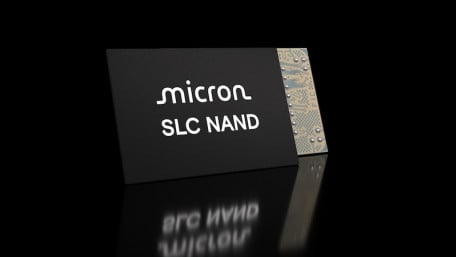
Micron’s 256-Gb radiation-tolerant SLC NAND meets tight aerospace reliability benchmarks.
Micron’s 256-Gb radiation-tolerant SLC NAND meets tight aerospace reliability benchmarks.

Memory selection has become a priority, as AI system designs demand more memory. Learn how to navigate hardware designs…
Memory selection has become a priority, as AI system designs demand more memory. Learn how to navigate hardware designs impacts and supply chain issues, and how BOM management tools help smooth the way.

Micron’s 1γ LPDDR5X memory delivers record-breaking speed and efficiency for AI at the edge.
Micron’s 1γ LPDDR5X memory delivers record-breaking speed and efficiency for AI at the edge.

With more memory-hungry AI applications around the corner, ST is future-proofing its automotive MCUs with a new solution…
With more memory-hungry AI applications around the corner, ST is future-proofing its automotive MCUs with a new solution based on its phase-change memory technology.

Enjoy this fresh crop of technology news from the Embedded World 2025 trade show in Nuremberg, Germany.
Enjoy this fresh crop of technology news from the Embedded World 2025 trade show in Nuremberg, Germany.

Announced at Embedded World 2025, Weebit Nano's ReRAM module has met a critical benchmark for ICs used in vehicles.
Announced at Embedded World 2025, Weebit Nano's ReRAM module has met a critical benchmark for ICs used in vehicles.

The new SSD, which leverages a PCIe Gen5 interface, may redefine data transfer speeds and reliability for AI PC OEMs.
The new SSD, which leverages a PCIe Gen5 interface, may redefine data transfer speeds and reliability for AI PC OEMs.

Generic concepts of computational storage are a dead end, but targeted accelerators leveraging the massive on-board…
Generic concepts of computational storage are a dead end, but targeted accelerators leveraging the massive on-board bandwidth of solid-state drives may benefit high-performance computing.

Infineon says the new solution is an industry first for radiation-hardened NOR Flash.
Infineon says the new solution is an industry first for radiation-hardened NOR Flash.

In this deep dive, we take a look at how Winbond’s CUBE technology solves memory challenges for edge AI designs.
In this deep dive, we take a look at how Winbond’s CUBE technology solves memory challenges for edge AI designs.

AI will push the limits of PCs and smartphones. In turn, demands on storage controller chips will be intense. Learn how…
AI will push the limits of PCs and smartphones. In turn, demands on storage controller chips will be intense. Learn how chip architectures and firmware schemes must be optimized for these AI workloads.

New memory technologies, including HBM4, DDR5 DRAM, and MRAM, each respond to various industries outgrowing current…
New memory technologies, including HBM4, DDR5 DRAM, and MRAM, each respond to various industries outgrowing current storage infrastructure.

Investments in semiconductor manufacturing have been on the rise in recent years. Here are a few new examples.
Investments in semiconductor manufacturing have been on the rise in recent years. Here are a few new examples.

Startups are using and supporting AI in a myriad of ways.
Startups are using and supporting AI in a myriad of ways.

At this year's Future of Memory and Storage show, Microchip, Micron, and Samsung presented new memory solutions in the…
At this year's Future of Memory and Storage show, Microchip, Micron, and Samsung presented new memory solutions in the age of AI—from SSD controllers to LPDDR5X DRAM.

MCUs that only do control tasks are one thing. But in today’s AI age, a truly AI-enabled MCU needs to offer more. Learn…
MCUs that only do control tasks are one thing. But in today’s AI age, a truly AI-enabled MCU needs to offer more. Learn the important factors—from optimized neural processing units (NPUs) to power efficient architectures to clever memory topologies.

Teledyne e2v’s chips target space-based applications with significantly improved performance, protection against…
Teledyne e2v’s chips target space-based applications with significantly improved performance, protection against radiation, and spatial efficiency.

New transistors, memory devices, and RF modules defy the radiation-saturated conditions of space.
New transistors, memory devices, and RF modules defy the radiation-saturated conditions of space.

Weebit Nano and Efabless are teaming up to make it easier for chip designers to prototype intelligent devices using…
Weebit Nano and Efabless are teaming up to make it easier for chip designers to prototype intelligent devices using Weebit's advanced memory technology.

The new Pascari brand will provide SSDs for data-heavy enterprise applications.
The new Pascari brand will provide SSDs for data-heavy enterprise applications.


 Facebook
 Google
 GitHub
 Linkedin