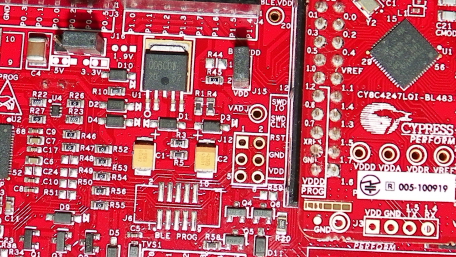
Getting started with PSoC®, the Programmable-System-on-Chip by Cypress Semiconductor for developing and testing embedded systems.
Getting started with PSoC®, the Programmable-System-on-Chip by Cypress Semiconductor for developing and testing embedded systems.

Beaglebone Black is the most recent incarnation of the Beaglebone open source hardware platform. For less than $50, the…
Beaglebone Black is the most recent incarnation of the Beaglebone open source hardware platform. For less than $50, the board includes Ethernet, graphics processing, 4Gb of nonvolatile storage, and ports supporting USB, HDMI, and Beaglebone's custom I/O add-ons, called "capes". Here's how to run some simple commands to toggle digital I/O on the board!

This is one simple way to control a LED, fan, relay or solenoid with a computer and a PIC.
This is one simple way to control a LED, fan, relay or solenoid with a computer and a PIC.

How to read humidity and temperature from a DHT11 and display it on a LCD with a PIC microcontroller. In this example…
How to read humidity and temperature from a DHT11 and display it on a LCD with a PIC microcontroller. In this example we're going to use a PIC16F628A.

Part 2 in the "How to Make an Ambient Light Monitor" Series. Our smart ambient light monitor will need to digitize and…
Part 2 in the "How to Make an Ambient Light Monitor" Series. Our smart ambient light monitor will need to digitize and analyze signals from an optical detector, so it is time to explore the EFM8’s integrated analog-to-digital conversion functionality.

This introduction to the PICAXE microcontroller overviews the economical, versatile, and fun-to-use MCU family with which…
This introduction to the PICAXE microcontroller overviews the economical, versatile, and fun-to-use MCU family with which all designers should become familiar.

Learn how to use an EFM8 microcontroller to convert current and voltage measurements to digits that can be displayed on…
Learn how to use an EFM8 microcontroller to convert current and voltage measurements to digits that can be displayed on an LCD. We'll discuss a convenient way to report analog-to-digital conversion values that represent current and voltage amplitudes.

Use the EFM8’s USB functionality to transfer an image from your PC to an LCD.
Use the EFM8’s USB functionality to transfer an image from your PC to an LCD.

Learn how to connect your device with Linux Screen using the built-in Lua interpreter to set up the file system and…
Learn how to connect your device with Linux Screen using the built-in Lua interpreter to set up the file system and connect to the network. Then, learn how to automate the scripting process with Luatool and put it all together with a basic TCP server that can interact with a pulse-width modulated LED, a potentiometer, and a switch.

The new 8-bit families have Core-Independent Peripherals, which allow the MCUs to be used in a much larger variety of…
The new 8-bit families have Core-Independent Peripherals, which allow the MCUs to be used in a much larger variety of interconnected CIPs that don't require a core to perform. The CIPs increase system performance with simple design and a 1.8 to 5.5V operating range.

Compile and install NodeMCU on the ESP8266 IoT chip using Linux tools and the ESP Open Source SDK
Compile and install NodeMCU on the ESP8266 IoT chip using Linux tools and the ESP Open Source SDK

Introduction to the Arduino SPI Library with example sketch for the LTC1286 12 Bit ADC and the DAC714 16 bit DAC.
Introduction to the Arduino SPI Library with example sketch for the LTC1286 12 Bit ADC and the DAC714 16 bit DAC.

Many embedded applications benefit from a communications interface that allows for convenient data transfer between a PC…
Many embedded applications benefit from a communications interface that allows for convenient data transfer between a PC and a microcontroller. This article explains how to use the virtual COM port library from Silicon Laboratories to send data from a Windows application to an EFM8 microcontroller.

The 08M2 is the smallest member of the PICAXE family of microcontrollers; it is inexpensive, versatile, and easy to…
The 08M2 is the smallest member of the PICAXE family of microcontrollers; it is inexpensive, versatile, and easy to program using free software.

Learn how to design characters using an image editor and display them on an LCD controlled by an EFM8 microcontroller.
Learn how to design characters using an image editor and display them on an LCD controlled by an EFM8 microcontroller.

A simple LCD control project with an EFM8 evaluation board demonstrates basic principles of embedded development.
A simple LCD control project with an EFM8 evaluation board demonstrates basic principles of embedded development.

Five of the coolest hardware Kickstarters!
Five of the coolest hardware Kickstarters!

This project will help you get started with the Arduino, including a description of the different types of Arduinos, how…
This project will help you get started with the Arduino, including a description of the different types of Arduinos, how to download the Arduino software development environment, and describe the different shields that are available for the Arduino along with the accessories you will need to develop Arduino projects.

Texas Instruments (TI) released today the industry’s first Near Field Communication (NFC) sensor transponder family.…
Texas Instruments (TI) released today the industry’s first Near Field Communication (NFC) sensor transponder family. The RF430RL25xH system-on-chip (SoC) device is equipped with a fully programmable low power microcontroller (MCU), non-volatile FRAM, an analog-to-digital converter (ADC) and supports an ISO 15693-compliant NFC interface as well as Serial Peripheral Interface (SPI) and Inter Integrated Circuit (I2C). The high frequency13.56-MHz sensor transponder can operate on full passive (battery-less) or semi-active modes for optimal battery life in portable and wireless sensing applications.


 Facebook
 Google
 GitHub
 Linkedin