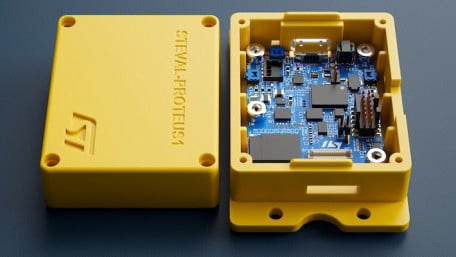
Learn how to use edge AI technology to do predictive maintenance, leveraging machine learning, vibration sensors, and wireless connectivity.
Learn how to use edge AI technology to do predictive maintenance, leveraging machine learning, vibration sensors, and wireless connectivity.

Angstrom-scale ICs will require innovation across the entire semiconductor ecosystem: This will include advances in both…
Angstrom-scale ICs will require innovation across the entire semiconductor ecosystem: This will include advances in both the hardware (transistors, power distribution, and connection of multi-die systems) and tools (EDA tools with AI/ML and silicon life-cycle management).

Generative AI tools like ChatGPT have had a huge impact in numerous sectors of society. As engineers, it’s helpful for…
Generative AI tools like ChatGPT have had a huge impact in numerous sectors of society. As engineers, it’s helpful for us to understand the computing technology that makes it possible.

"Edge intelligence" is becoming more accessible—even to those designers without formal data science training—as new…
"Edge intelligence" is becoming more accessible—even to those designers without formal data science training—as new hardware becomes available.

Leveraging board-level cameras offer a variety of benefits. To help identify the right mix of features and design…
Leveraging board-level cameras offer a variety of benefits. To help identify the right mix of features and design elements, here are some factors to consider when selecting and designing in an embedded machine vision camera.

Learn how the i.MX 8M Plus applications processor enables edge computing, speeding up machine learning for a variety of…
Learn how the i.MX 8M Plus applications processor enables edge computing, speeding up machine learning for a variety of applications including industrial tasks.

This article looks at digit detection and recognition using MNIST eIQ as an example, which consists of several parts —…
This article looks at digit detection and recognition using MNIST eIQ as an example, which consists of several parts — the digit recognition is performed by a TensorFlow Lite model, and a GUI is used to increase the usability of the i.MX RT1060 device.

This article discusses trusted execution environments — already used in a variety of connected devices — by showing…
This article discusses trusted execution environments — already used in a variety of connected devices — by showing how using TEE and an FPGA SoC can work in vehicle in-cabin AI.

With the adoption of artificial intelligence and machine learning in a wide variety of applications, reliability…
With the adoption of artificial intelligence and machine learning in a wide variety of applications, reliability verification of AI/ML processors is critical since failures can have major consequences for the validity and legitimacy of AI/ML technology.

Historically, FPGAs have been challenging to work with. To combat that reputation, Xilinx developed programmable devices…
Historically, FPGAs have been challenging to work with. To combat that reputation, Xilinx developed programmable devices that simplify—and accelerate—the implementation of customized hardware development.

SoCs with programmable logic are an essential element of real-time embedded vision systems. Designers can capitalize on…
SoCs with programmable logic are an essential element of real-time embedded vision systems. Designers can capitalize on the power and efficiency of Xilinx's Zynq Ultrascale+ MPSoC devices to implement their designs using Avnet's Embedded Vision Kits and the Xilinx reVISION stack.

In this multipart industrial IoT series, we will break down and explore the fundamental aspects of the edge node…
In this multipart industrial IoT series, we will break down and explore the fundamental aspects of the edge node interpretation within the larger IoT framework: sensing, measuring, interpreting, and connecting data, with additional consideration for power management and security.

The industrial Internet of Things (IoT) encompasses the broad transformation underway that will make pervasive sensing…
The industrial Internet of Things (IoT) encompasses the broad transformation underway that will make pervasive sensing across connected machines not just a competitive advantage, but an essential fundamental service. The industrial IoT starts with the edge node, which is the sensing and measurement entry point of interest.

Optimizing performance, safety, and reliability in ADAS applications via design, verification, and processor IP and a…
Optimizing performance, safety, and reliability in ADAS applications via design, verification, and processor IP and a holistic design approach.


 Facebook
 Google
 GitHub
 Linkedin