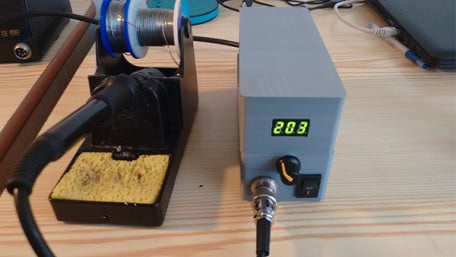
The mighty soldering iron. If you need one, want one, or just love to build stuff, then this project is for you.
The mighty soldering iron. If you need one, want one, or just love to build stuff, then this project is for you.

Part One in this three-article series focuses on using the SAM4S timer/counter peripheral to precisely control the…
Part One in this three-article series focuses on using the SAM4S timer/counter peripheral to precisely control the DAC’s sampling rate.

Learn how to communicate between your PC and the SAM4S using the Atmel Software Framework’s USB module and simple ASCII…
Learn how to communicate between your PC and the SAM4S using the Atmel Software Framework’s USB module and simple ASCII commands.

In this article we’ll use the SAM4S Xplained Pro development platform to get some hands-on experience with a PWM DAC.
In this article we’ll use the SAM4S Xplained Pro development platform to get some hands-on experience with a PWM DAC.

In this week’s Teardown Tuesday we're going to take a look at the inside of a Fitbit Charge.
In this week’s Teardown Tuesday we're going to take a look at the inside of a Fitbit Charge.

The new development board features a 32 MHz Quark and a host of features at a $14.95 price tag.
The new development board features a 32 MHz Quark and a host of features at a $14.95 price tag.

This article covers everything you need to know to generate pulse-width-modulated signals with Atmel’s SAM4S Xplained…
This article covers everything you need to know to generate pulse-width-modulated signals with Atmel’s SAM4S Xplained Pro development board.

This article provides additional details related to code development, hardware configuration, and the OLED interface.
This article provides additional details related to code development, hardware configuration, and the OLED interface.

Some cool microcontroller kits for young engineers are coming, check them out!
Some cool microcontroller kits for young engineers are coming, check them out!

Ever wonder what's inside a radar detector? In this week's Teardown Tuesday you'll find out!
Ever wonder what's inside a radar detector? In this week's Teardown Tuesday you'll find out!

In this week's teardown Tuesday we are going to take a look inside an RC car transmitter.
In this week's teardown Tuesday we are going to take a look inside an RC car transmitter.

Readers will learn how to wire a standard 16x2 LCD (liquid crystal display) to a Raspberry Pi to display messages.
Readers will learn how to wire a standard 16x2 LCD (liquid crystal display) to a Raspberry Pi to display messages.

No I2C interface with that sensor? No problem. Program a PIC chip as an I2C slave device for custom sensor and I/O…
No I2C interface with that sensor? No problem. Program a PIC chip as an I2C slave device for custom sensor and I/O interfacing. Here, we use three DHT22 sensors on a single I2C interface.

In this edition of teardown Tuesday, we'll be examining the Amazon Dash button.
In this edition of teardown Tuesday, we'll be examining the Amazon Dash button.

With USB communications and a Scilab graphical user interface, we can really see what the PID controller is doing.
With USB communications and a Scilab graphical user interface, we can really see what the PID controller is doing.

Lasers are plentiful, inexpensive, and fun to use. Here's a target that reacts when it's hit by a laser beam.
Lasers are plentiful, inexpensive, and fun to use. Here's a target that reacts when it's hit by a laser beam.

Learn how to read electrical signals and data from an analog device using the Step Response technique in Part 5 of the…
Learn how to read electrical signals and data from an analog device using the Step Response technique in Part 5 of the Building Raspberry Pi Controllers series.

This article covers the firmware that allows the EFM8 microcontroller to communicate with the DAC and the MAX31855.
This article covers the firmware that allows the EFM8 microcontroller to communicate with the DAC and the MAX31855.

Invoke the power of the PID (proportional–integral–derivative controller)! The key components in this design are an…
Invoke the power of the PID (proportional–integral–derivative controller)! The key components in this design are an EFM8 microcontroller, a DAC, and the MAX31855 thermocouple-to-digital converter.

In this article I'll show you one way to use a PIC microcontroller to get the time and date from a GPS module.
In this article I'll show you one way to use a PIC microcontroller to get the time and date from a GPS module.


 Facebook
 Google
 GitHub
 Linkedin