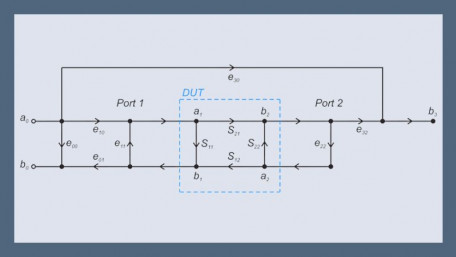
The 12-term error model is a simple, effective way of modeling systematic errors in vector network analyzer (VNA) measurements. Learn about this model and an…
The 12-term error model is a simple, effective way of modeling systematic errors in vector network analyzer (VNA) measurements. Learn about this model and an associated error correction technique in this article.

In this article, we compare the scope of factory and user calibration for vector network analyzers (VNAs). We then learn…
In this article, we compare the scope of factory and user calibration for vector network analyzers (VNAs). We then learn about the types of errors that calibration techniques can't correct.

Learn the basics of how vector network analyzer (VNA) calibration techniques correct measurement errors.
Learn the basics of how vector network analyzer (VNA) calibration techniques correct measurement errors.

This article explains how to estimate the dynamic range a vector network analyzer (VNA) needs for a given measurement,…
This article explains how to estimate the dynamic range a vector network analyzer (VNA) needs for a given measurement, then discusses four techniques for boosting the dynamic range to the required level.

In this article, we investigate two metrics used to characterize the performance of RF test and measurement systems.
In this article, we investigate two metrics used to characterize the performance of RF test and measurement systems.

In this article, we explore how the signal source and receivers of a VNA enable its function.
In this article, we explore how the signal source and receivers of a VNA enable its function.

Directional couplers are valuable tools for testing RF systems. However, the finite directivity of these devices can…
Directional couplers are valuable tools for testing RF systems. However, the finite directivity of these devices can cause measurement uncertainty. Learn more in this article.

The small-signal characteristics of MOSFETs play an important role in analog IC design. In this article, we learn how to…
The small-signal characteristics of MOSFETs play an important role in analog IC design. In this article, we learn how to model MOS transistors' small-signal behaviors.

This article explains how to use a histogram test with a sinusoidal input to determine analog-to-digital converter (ADC)…
This article explains how to use a histogram test with a sinusoidal input to determine analog-to-digital converter (ADC) parameters, along with the advantages of doing so.

Histogram testing is the most popular method for determining analog-to-digital converter (ADC) static parameters. In this…
Histogram testing is the most popular method for determining analog-to-digital converter (ADC) static parameters. In this article, learn the basics of histogram testing and the specifics of how to use a linear ramp histogram test.

In this article, we’ll take a look at how servo-loop ADC test parameters can be chosen based on the noise level of the…
In this article, we’ll take a look at how servo-loop ADC test parameters can be chosen based on the noise level of the ADC and the desired measurement precision.

Learn about various types of filters, including common terminology and important characteristics.
Learn about various types of filters, including common terminology and important characteristics.

Electromagnetic-based side-channel attacks are non-invasive, meaning the attacker does not need physical access to the…
Electromagnetic-based side-channel attacks are non-invasive, meaning the attacker does not need physical access to the device to steal information. We’ll look at how these EM side-channel attacks work.

Indispensable for modern electrical engineering, application-specific integrated circuits (ASICs) form a diverse group of…
Indispensable for modern electrical engineering, application-specific integrated circuits (ASICs) form a diverse group of integrated circuits (ICs) that help designers to optimize sophisticated electronic devices.

Real-time image processing is a resource-intensive task that often requires specialized hardware. With that in mind,…
Real-time image processing is a resource-intensive task that often requires specialized hardware. With that in mind, let's explore processors that are designed specifically for photo and video applications.

An encoding technique used for digital communication, pulse amplitude modulation (PAM) converts a discrete-time signal…
An encoding technique used for digital communication, pulse amplitude modulation (PAM) converts a discrete-time signal into a variable-amplitude continuous-time signal that is suitable for high-speed wired communication systems.

Learn about eliminating missing codes through averaging, analog-to-digital converter (ADC) monotonicity, and the effect…
Learn about eliminating missing codes through averaging, analog-to-digital converter (ADC) monotonicity, and the effect of ADC nonlinearity on the system's signal-to-noise ratio (SNR).

Learn about digital square wave generators using a ring oscillator, a 555 timer-based oscillator, and an…
Learn about digital square wave generators using a ring oscillator, a 555 timer-based oscillator, and an Arduino-generated square wave oscillator.

Learn about the importance of the Fourier series in circuit analysis and the Fourier series equations, while gaining…
Learn about the importance of the Fourier series in circuit analysis and the Fourier series equations, while gaining insight into how this analysis tool works.

Learn about how system nonlinearity creates distortion in audio signals that impacts the sounds we hear. We will examine…
Learn about how system nonlinearity creates distortion in audio signals that impacts the sounds we hear. We will examine sine waves, harmonics, and intermodulation distortion.


 Facebook
 Google
 GitHub
 Linkedin
