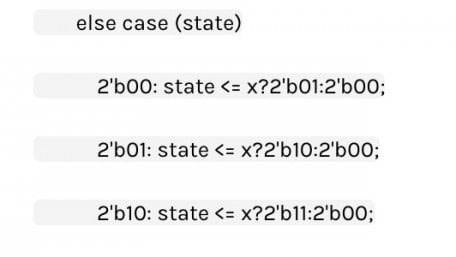
This article discusses the use of finite state machines (or FSMs) in design, including the initial state and the way memory configuration affects FPGA design.
This article discusses the use of finite state machines (or FSMs) in design, including the initial state and the way memory configuration affects FPGA design.

How can you build a fast non-volatile memory from a conventional SRAM? It turns out, you only need a back-up battery and…
How can you build a fast non-volatile memory from a conventional SRAM? It turns out, you only need a back-up battery and some control circuitry.

This article shows how to initialize arrays in a C program with values from text files.
This article shows how to initialize arrays in a C program with values from text files.

Learn how to use code memory to free up RAM on your MCU.
Learn how to use code memory to free up RAM on your MCU.

This article will explore what virtual memory is, why it exists, and how it works from a high level.
This article will explore what virtual memory is, why it exists, and how it works from a high level.

This article will take a closer look at the commands used to control and interact with DRAM.
This article will take a closer look at the commands used to control and interact with DRAM.

This article will examine the basic operation of Dynamic Random Access Memory (DRAM), along with how a DRAM chip is organized.
This article will examine the basic operation of Dynamic Random Access Memory (DRAM), along with how a DRAM chip is organized.

This article will examine principles of CPU cache design including locality, logical organization, and management heuristics.
This article will examine principles of CPU cache design including locality, logical organization, and management heuristics.

In this how-to article, we explore the use of I2C EERAM to save critical program variables when power fails and restore…
In this how-to article, we explore the use of I2C EERAM to save critical program variables when power fails and restore them when power returns to easily preserve program continuity.

The FPGA can be a great addition to your arsenal, but it requires some adjustments to the way a microcontroller jockey thinks.
The FPGA can be a great addition to your arsenal, but it requires some adjustments to the way a microcontroller jockey thinks.

File systems can be great for handling data and organizing memory, but most file systems require large amounts of memory.…
File systems can be great for handling data and organizing memory, but most file systems require large amounts of memory. This is where MicroFAT comes in!

We've all been there - you've spent hours and hours trying to get that sketch working, but somehow, you're not reacting…
We've all been there - you've spent hours and hours trying to get that sketch working, but somehow, you're not reacting well to time critical events in your system. Maybe it's a wireless peripheral indicating when a packet is ready. Maybe it's an external Flash device signaling when data is ready to be read out. Maybe it's as simple as a button push that you need to react quickly to! But, try as you might, it seems the best way to see these sort of events is to just digitalRead() that pin over and over in your main loop() function until something interesting happens. ...or is it?


 Facebook
 Google
 GitHub
 Linkedin