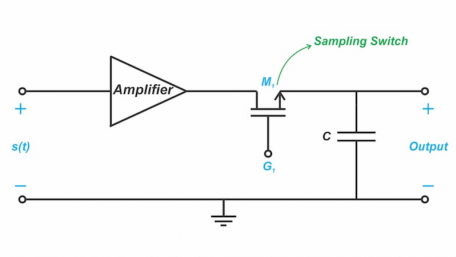
The aperture effect rolls off high message frequencies in flat-top PAM. Here’s how pulse duration limits that distortion to under 0.5% and when an equalizer helps.
The aperture effect rolls off high message frequencies in flat-top PAM. Here’s how pulse duration limits that distortion to under 0.5% and when an equalizer helps.

Flat-top PAM holds each sample’s amplitude for the pulse duration, weighting the spectrum with a sinc function.…
Flat-top PAM holds each sample’s amplitude for the pulse duration, weighting the spectrum with a sinc function. Here’s how that weighting leads to the aperture effect.

Multiplying a message by a pulse train replicates its spectrum at every harmonic. See why a 1/3 duty cycle and 4x…
Multiplying a message by a pulse train replicates its spectrum at every harmonic. See why a 1/3 duty cycle and 4x oversampling stretch the bandwidth roughly 12-fold.

This project brief describes how to build and use an Arduino-compatible interface board that reads an on-board pressure…
This project brief describes how to build and use an Arduino-compatible interface board that reads an on-board pressure sensor and reports the measurement over an RS-485 network.

This project brief describes how to build and use an Arduino-compatible relay interface board that switches a 10 A load…
This project brief describes how to build and use an Arduino-compatible relay interface board that switches a 10 A load over an RS-485 network.

This project brief describes how to build and use an Arduino-compatible board that reads a linear Hall-effect sensor and…
This project brief describes how to build and use an Arduino-compatible board that reads a linear Hall-effect sensor and reports the measurement over an RS-485 bus.

Deriving a general signal-to-noise expression for frequency modulation with any message signal reveals a core trade-off:…
Deriving a general signal-to-noise expression for frequency modulation with any message signal reveals a core trade-off: more deviation buys better noise performance, but only by using more bandwidth.

This article explores how combining signal and noise power reveals how the FM system’s output SNR scales with carrier…
This article explores how combining signal and noise power reveals how the FM system’s output SNR scales with carrier amplitude and modulation index.
Explore how frequency-modulated waves resist interference. We break down the demodulator architecture and derive the…
Explore how frequency-modulated waves resist interference. We break down the demodulator architecture and derive the exact output signal power for a sinusoidal message.

Envelope detection is simple, but that simplicity has a noise-performance cost. Here’s how much SNR conventional AM…
Envelope detection is simple, but that simplicity has a noise-performance cost. Here’s how much SNR conventional AM gives up compared to its coherent counterparts.

Using a graphical approach, we show that coherent SSB demodulation leaves the input and output SNR unchanged, then…
Using a graphical approach, we show that coherent SSB demodulation leaves the input and output SNR unchanged, then compare its noise performance to DSB-SC and baseband systems.

This project brief describes how to build and use a four-channel differential line receiver module for balanced RS-422…
This project brief describes how to build and use a four-channel differential line receiver module for balanced RS-422 and RS-485 data links.

Visualizing how correlated and uncorrelated signals combine offers an intuitive look at power transformation. See how…
Visualizing how correlated and uncorrelated signals combine offers an intuitive look at power transformation. See how this difference boosts baseband power to double the output SNR.

This project brief describes how to implement a four-channel differential line driver module for reliable long-distance…
This project brief describes how to implement a four-channel differential line driver module for reliable long-distance data transmission over balanced twisted-pair lines.

In this article, we'll learn how to calculate the noise power and signal-to-noise ratio (SNR) of a double-sideband…
In this article, we'll learn how to calculate the noise power and signal-to-noise ratio (SNR) of a double-sideband suppressed-carrier communication system.

This article explains the importance of incorporating delay into the feedback path of a phase/frequency detector (PFD)…
This article explains the importance of incorporating delay into the feedback path of a phase/frequency detector (PFD) and examines its effect on performance.

Learn how using a phase/frequency detector (PFD) in place of a phase detector improves the acquisition range of a PLL.
Learn how using a phase/frequency detector (PFD) in place of a phase detector improves the acquisition range of a PLL.

The phase-locked loop (PLL) is widely used in contemporary analog and digital communication systems. In this article, we…
The phase-locked loop (PLL) is widely used in contemporary analog and digital communication systems. In this article, we develop a nonlinear model for the analog PLL by analyzing its key components.

Learn how Bessel functions and the modulation index can help us understand the bandwidth of wideband frequency-modulated…
Learn how Bessel functions and the modulation index can help us understand the bandwidth of wideband frequency-modulated (FM) signals.

This article explores the effect of signal bandwidth on the linearity of power amplifiers, including the impacts of…
This article explores the effect of signal bandwidth on the linearity of power amplifiers, including the impacts of cascaded RF gain stages.


 Facebook
 Google
 GitHub
 Linkedin
