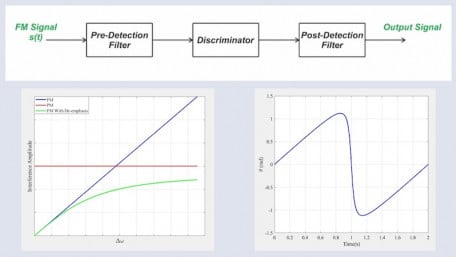
Interference in FM grows stronger with frequency offset, until pre-emphasis flattens the curve. See why a signal just twice as strong as a rival broadcast can…
Interference in FM grows stronger with frequency offset, until pre-emphasis flattens the curve. See why a signal just twice as strong as a rival broadcast can completely capture the channel.

Pre-emphasis and de-emphasis boost noise performance in FM, but only up to a point—push the gain too far and you risk…
Pre-emphasis and de-emphasis boost noise performance in FM, but only up to a point—push the gain too far and you risk overmodulation.

Simple first-order pre-emphasis and de-emphasis filters can boost FM receiver SNR by more than 13 dB by exploiting the…
Simple first-order pre-emphasis and de-emphasis filters can boost FM receiver SNR by more than 13 dB by exploiting the spectral differences between signal and noise.

Worked examples quantify just how much the FMFB loop shrinks noise bandwidth. We also show how the PLL demodulator offers…
Worked examples quantify just how much the FMFB loop shrinks noise bandwidth. We also show how the PLL demodulator offers a simpler alternative for reducing threshold.

While feedback lowers the FM detection threshold, it offers no noise advantage over conventional receivers when the…
While feedback lowers the FM detection threshold, it offers no noise advantage over conventional receivers when the carrier power is strong. Discover why in this discussion and mathematical analysis.

By closing a feedback loop around the demodulator, the FMFB architecture narrows the noise bandwidth and lowers the FM…
By closing a feedback loop around the demodulator, the FMFB architecture narrows the noise bandwidth and lowers the FM threshold, without improving SNR at high CNR.

Working through examples shows how the threshold effect reshapes FM design choices. See how ignoring it can undershoot…
Working through examples shows how the threshold effect reshapes FM design choices. See how ignoring it can undershoot the required carrier power by over 5x for the same target SNR.

The standard FM SNR equation breaks down once the carrier-to-noise ratio drops below a critical threshold, revealing a…
The standard FM SNR equation breaks down once the carrier-to-noise ratio drops below a critical threshold, revealing a hard limit on trading bandwidth for noise performance.

Deriving a general signal-to-noise expression for frequency modulation with any message signal reveals a core trade-off:…
Deriving a general signal-to-noise expression for frequency modulation with any message signal reveals a core trade-off: more deviation buys better noise performance, but only by using more bandwidth.

This article explores how combining signal and noise power reveals how the FM system’s output SNR scales with carrier…
This article explores how combining signal and noise power reveals how the FM system’s output SNR scales with carrier amplitude and modulation index.
Explore how frequency-modulated waves resist interference. We break down the demodulator architecture and derive the…
Explore how frequency-modulated waves resist interference. We break down the demodulator architecture and derive the exact output signal power for a sinusoidal message.

Envelope detection is simple, but that simplicity has a noise-performance cost. Here’s how much SNR conventional AM…
Envelope detection is simple, but that simplicity has a noise-performance cost. Here’s how much SNR conventional AM gives up compared to its coherent counterparts.

Using a graphical approach, we show that coherent SSB demodulation leaves the input and output SNR unchanged, then…
Using a graphical approach, we show that coherent SSB demodulation leaves the input and output SNR unchanged, then compare its noise performance to DSB-SC and baseband systems.

Visualizing how correlated and uncorrelated signals combine offers an intuitive look at power transformation. See how…
Visualizing how correlated and uncorrelated signals combine offers an intuitive look at power transformation. See how this difference boosts baseband power to double the output SNR.

In this article, we'll learn how to calculate the noise power and signal-to-noise ratio (SNR) of a double-sideband…
In this article, we'll learn how to calculate the noise power and signal-to-noise ratio (SNR) of a double-sideband suppressed-carrier communication system.

In this article, we analyze how bandpass filtering affects the power spectral density (PSD) of noise and explore how…
In this article, we analyze how bandpass filtering affects the power spectral density (PSD) of noise and explore how noise can be described by in-phase and quadrature components.

In this article, we'll learn about several key applications of PLLs in communication systems, including tracking filters,…
In this article, we'll learn about several key applications of PLLs in communication systems, including tracking filters, frequency and phase modulation, and FM and AM demodulation.

Learn how PLLs enable communication in which a clock signal is not transmitted with the data. We’ll look specifically…
Learn how PLLs enable communication in which a clock signal is not transmitted with the data. We’ll look specifically at return-to-zero (RZ) and non-return-to-zero (NRZ) data formats.

This article explains the importance of incorporating delay into the feedback path of a phase/frequency detector (PFD)…
This article explains the importance of incorporating delay into the feedback path of a phase/frequency detector (PFD) and examines its effect on performance.

Learn how using a phase/frequency detector (PFD) in place of a phase detector improves the acquisition range of a PLL.
Learn how using a phase/frequency detector (PFD) in place of a phase detector improves the acquisition range of a PLL.


 Facebook
 Google
 GitHub
 Linkedin