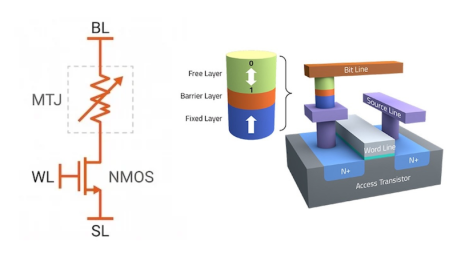
Learn about magnetoresistive random-access memory technology and what changes it brings for embedded products, including firmware updates and data logging.
Learn about magnetoresistive random-access memory technology and what changes it brings for embedded products, including firmware updates and data logging.

Learn how analog and digital circuits can implement these compression methods to improve SNR for low-amplitude voice signals.
Learn how analog and digital circuits can implement these compression methods to improve SNR for low-amplitude voice signals.

Uniform quantization adds the same noise power at every level, so SNR collapses for soft speech. See how compressing the…
Uniform quantization adds the same noise power at every level, so SNR collapses for soft speech. See how compressing the signal first makes noise track signal power and holds SNR steady.

PCM converts an analog signal into a bit stream by sampling, quantizing, and encoding. See how a 3-bit quantizer reduces…
PCM converts an analog signal into a bit stream by sampling, quantizing, and encoding. See how a 3-bit quantizer reduces each sample to one of 8 levels.

The aperture effect rolls off high message frequencies in flat-top PAM. Here’s how pulse duration limits that…
The aperture effect rolls off high message frequencies in flat-top PAM. Here’s how pulse duration limits that distortion to under 0.5% and when an equalizer helps.

Flat-top PAM holds each sample’s amplitude for the pulse duration, weighting the spectrum with a sinc function.…
Flat-top PAM holds each sample’s amplitude for the pulse duration, weighting the spectrum with a sinc function. Here’s how that weighting leads to the aperture effect.

Multiplying a message by a pulse train replicates its spectrum at every harmonic. See why a 1/3 duty cycle and 4x…
Multiplying a message by a pulse train replicates its spectrum at every harmonic. See why a 1/3 duty cycle and 4x oversampling stretch the bandwidth roughly 12-fold.

This project brief describes how to build and use an Arduino-compatible interface board that reads an on-board pressure…
This project brief describes how to build and use an Arduino-compatible interface board that reads an on-board pressure sensor and reports the measurement over an RS-485 network.

This project brief describes how to build and use an Arduino-compatible interface board that reads a 2-axis thumb…
This project brief describes how to build and use an Arduino-compatible interface board that reads a 2-axis thumb joystick and transmits its position over an RS-485 network.

This project brief describes how to build and use an Arduino-compatible relay interface board that switches a 10 A load…
This project brief describes how to build and use an Arduino-compatible relay interface board that switches a 10 A load over an RS-485 network.

Discover how the LT1079 quad op-amp minimizes sensor loading in battery-powered designs. Active cancellation and an…
Discover how the LT1079 quad op-amp minimizes sensor loading in battery-powered designs. Active cancellation and an onboard bridge network ensure maximum precision for resistive sensors.

This project brief describes how to build and use an Arduino-compatible board that reads a linear Hall-effect sensor and…
This project brief describes how to build and use an Arduino-compatible board that reads a linear Hall-effect sensor and reports the measurement over an RS-485 bus.

This article shows you how to configure Software Standby mode and implement a periodic wake-up routine on the Renesas…
This article shows you how to configure Software Standby mode and implement a periodic wake-up routine on the Renesas FPB-RA0E1 Fast Prototyping Board, built around the Arm Cortex-M23-based RA0E1 MCU.

Deriving a general signal-to-noise expression for frequency modulation with any message signal reveals a core trade-off:…
Deriving a general signal-to-noise expression for frequency modulation with any message signal reveals a core trade-off: more deviation buys better noise performance, but only by using more bandwidth.

This article explores how combining signal and noise power reveals how the FM system’s output SNR scales with carrier…
This article explores how combining signal and noise power reveals how the FM system’s output SNR scales with carrier amplitude and modulation index.
Explore how frequency-modulated waves resist interference. We break down the demodulator architecture and derive the…
Explore how frequency-modulated waves resist interference. We break down the demodulator architecture and derive the exact output signal power for a sinusoidal message.

Build a low-noise, 32-bit delta-sigma ADC board designed around the ADS1262. This 10-channel design features integrated…
Build a low-noise, 32-bit delta-sigma ADC board designed around the ADS1262. This 10-channel design features integrated signal conditioning for RTDs, thermocouples, and strain gauges.

Envelope detection is simple, but that simplicity has a noise-performance cost. Here’s how much SNR conventional AM…
Envelope detection is simple, but that simplicity has a noise-performance cost. Here’s how much SNR conventional AM gives up compared to its coherent counterparts.

Build an ultra-low-noise preamplifier with a JFE150 JFET and OPA202 op-amp, perfect for high-impedance sensors,…
Build an ultra-low-noise preamplifier with a JFE150 JFET and OPA202 op-amp, perfect for high-impedance sensors, hydrophones, guitar pickups, microphones, and turntables.

Using a graphical approach, we show that coherent SSB demodulation leaves the input and output SNR unchanged, then…
Using a graphical approach, we show that coherent SSB demodulation leaves the input and output SNR unchanged, then compare its noise performance to DSB-SC and baseband systems.


 Facebook
 Google
 GitHub
 Linkedin
