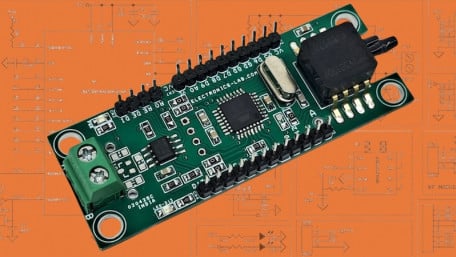
This project brief describes how to build and use an Arduino-compatible interface board that reads an on-board pressure sensor and reports the measurement over…
This project brief describes how to build and use an Arduino-compatible interface board that reads an on-board pressure sensor and reports the measurement over an RS-485 network.

Pre-emphasis and de-emphasis boost noise performance in FM, but only up to a point—push the gain too far and you risk…
Pre-emphasis and de-emphasis boost noise performance in FM, but only up to a point—push the gain too far and you risk overmodulation.

This project brief describes how to build and use an Arduino-compatible interface board that reads a 2-axis thumb…
This project brief describes how to build and use an Arduino-compatible interface board that reads a 2-axis thumb joystick and transmits its position over an RS-485 network.

Simple first-order pre-emphasis and de-emphasis filters can boost FM receiver SNR by more than 13 dB by exploiting the…
Simple first-order pre-emphasis and de-emphasis filters can boost FM receiver SNR by more than 13 dB by exploiting the spectral differences between signal and noise.

Worked examples quantify just how much the FMFB loop shrinks noise bandwidth. We also show how the PLL demodulator offers…
Worked examples quantify just how much the FMFB loop shrinks noise bandwidth. We also show how the PLL demodulator offers a simpler alternative for reducing threshold.

While feedback lowers the FM detection threshold, it offers no noise advantage over conventional receivers when the…
While feedback lowers the FM detection threshold, it offers no noise advantage over conventional receivers when the carrier power is strong. Discover why in this discussion and mathematical analysis.

This project brief describes how to build a compact, single-supply preamplifier module that converts the output of an…
This project brief describes how to build a compact, single-supply preamplifier module that converts the output of an electret microphone into a usable line-level audio signal.

By closing a feedback loop around the demodulator, the FMFB architecture narrows the noise bandwidth and lowers the FM…
By closing a feedback loop around the demodulator, the FMFB architecture narrows the noise bandwidth and lowers the FM threshold, without improving SNR at high CNR.

Working through examples shows how the threshold effect reshapes FM design choices. See how ignoring it can undershoot…
Working through examples shows how the threshold effect reshapes FM design choices. See how ignoring it can undershoot the required carrier power by over 5x for the same target SNR.

This project brief describes how to build and use an Arduino-compatible board that reads a linear Hall-effect sensor and…
This project brief describes how to build and use an Arduino-compatible board that reads a linear Hall-effect sensor and reports the measurement over an RS-485 bus.

The standard FM SNR equation breaks down once the carrier-to-noise ratio drops below a critical threshold, revealing a…
The standard FM SNR equation breaks down once the carrier-to-noise ratio drops below a critical threshold, revealing a hard limit on trading bandwidth for noise performance.

Learn how to construct a robust DMOS-based board featuring mute and standby controls. It easily drives 4 or 8 Ω loads…
Learn how to construct a robust DMOS-based board featuring mute and standby controls. It easily drives 4 or 8 Ω loads for your next custom stereo or speaker project.

Deriving a general signal-to-noise expression for frequency modulation with any message signal reveals a core trade-off:…
Deriving a general signal-to-noise expression for frequency modulation with any message signal reveals a core trade-off: more deviation buys better noise performance, but only by using more bandwidth.

This article explores how combining signal and noise power reveals how the FM system’s output SNR scales with carrier…
This article explores how combining signal and noise power reveals how the FM system’s output SNR scales with carrier amplitude and modulation index.

This project brief describes how to build a compact dual-channel power amplifier module that delivers 38 W per channel…
This project brief describes how to build a compact dual-channel power amplifier module that delivers 38 W per channel into 4-ohm speakers using STMicroelectronics' STA540 audio amplifier IC.
Explore how frequency-modulated waves resist interference. We break down the demodulator architecture and derive the…
Explore how frequency-modulated waves resist interference. We break down the demodulator architecture and derive the exact output signal power for a sinusoidal message.

Build a low-noise, 32-bit delta-sigma ADC board designed around the ADS1262. This 10-channel design features integrated…
Build a low-noise, 32-bit delta-sigma ADC board designed around the ADS1262. This 10-channel design features integrated signal conditioning for RTDs, thermocouples, and strain gauges.

Envelope detection is simple, but that simplicity has a noise-performance cost. Here’s how much SNR conventional AM…
Envelope detection is simple, but that simplicity has a noise-performance cost. Here’s how much SNR conventional AM gives up compared to its coherent counterparts.

Build an ultra-low-noise preamplifier with a JFE150 JFET and OPA202 op-amp, perfect for high-impedance sensors,…
Build an ultra-low-noise preamplifier with a JFE150 JFET and OPA202 op-amp, perfect for high-impedance sensors, hydrophones, guitar pickups, microphones, and turntables.

Using a graphical approach, we show that coherent SSB demodulation leaves the input and output SNR unchanged, then…
Using a graphical approach, we show that coherent SSB demodulation leaves the input and output SNR unchanged, then compare its noise performance to DSB-SC and baseband systems.


 Facebook
 Google
 GitHub
 Linkedin