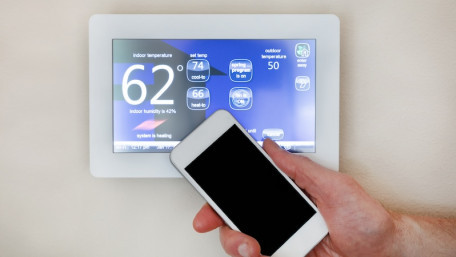
Thread, a network protocol released July 2015, is optimized for the connected home network. It is IPv6 based, uses IEEE Standard 802.15.4 and runs on existing hardware.
Thread, a network protocol released July 2015, is optimized for the connected home network. It is IPv6 based, uses IEEE Standard 802.15.4 and runs on existing hardware.

How to create a custom BLE GATT peripheral using the nRF51 by creating a service and characteristics.
How to create a custom BLE GATT peripheral using the nRF51 by creating a service and characteristics.

Learn how to communicate with a custom BLE peripheral using an Android device.
Learn how to communicate with a custom BLE peripheral using an Android device.

MQ Telemetry Transport (MQTT) is a popular low-overhead messaging protocol used by many IoT devices to communicate. This…
MQ Telemetry Transport (MQTT) is a popular low-overhead messaging protocol used by many IoT devices to communicate. This tutorial will show the user how to to set up a basic MQTT network using Python on his or her computer and an ESP8266 running the NodeMCU firmware.

How to set up the build environment for the nRF51 system-on-chip using makefiles and ARM-GCC.
How to set up the build environment for the nRF51 system-on-chip using makefiles and ARM-GCC.

Adding variable speed control and battery monitoring to a Power Wheels truck!
Adding variable speed control and battery monitoring to a Power Wheels truck!

Learn how to set up the Wunderbar platform to begin building your own IoT apps. This will demonstrate the "Can't Touch…
Learn how to set up the Wunderbar platform to begin building your own IoT apps. This will demonstrate the "Can't Touch This" and "Tell Me When" demo applications to measure WunderBar sensors and perform actions based on them. Some of the major bugs are discussed.

Getting started with PSoC®, the Programmable-System-on-Chip by Cypress Semiconductor for developing and testing embedded systems.
Getting started with PSoC®, the Programmable-System-on-Chip by Cypress Semiconductor for developing and testing embedded systems.

This article will go into a bit of the background of FSK and demonstrate writing a simulator in Python.
This article will go into a bit of the background of FSK and demonstrate writing a simulator in Python.

Create a smart home by displaying the current salt level of your water softener with the CC3200 and a proximity sensor.
Create a smart home by displaying the current salt level of your water softener with the CC3200 and a proximity sensor.

This article is part 2 of a two-part series that introduces the tools and techniques for programming PICAXE…
This article is part 2 of a two-part series that introduces the tools and techniques for programming PICAXE microcontrollers. Part 1 focused on construction of a test circuit and the AXEpad IDE; part 2 covers the PICAXE Editor 6 IDE.

We've all been there - you've spent hours and hours trying to get that sketch working, but somehow, you're not reacting…
We've all been there - you've spent hours and hours trying to get that sketch working, but somehow, you're not reacting well to time critical events in your system. Maybe it's a wireless peripheral indicating when a packet is ready. Maybe it's an external Flash device signaling when data is ready to be read out. Maybe it's as simple as a button push that you need to react quickly to! But, try as you might, it seems the best way to see these sort of events is to just digitalRead() that pin over and over in your main loop() function until something interesting happens. ...or is it?

Detect audio with an electret microphone and a TI CC3200 Wifi microcontroller. This handy project will allow you to set…
Detect audio with an electret microphone and a TI CC3200 Wifi microcontroller. This handy project will allow you to set up an audio detection device that can be used to catch your roommate stealing things from the fridge or send you an alert if the noise in your room goes above a certain threshold.

How to interface a Raspberry Pi to an I2C temperature sensor (TMP102) and then publish the data to a Google sheet and graph.
How to interface a Raspberry Pi to an I2C temperature sensor (TMP102) and then publish the data to a Google sheet and graph.

This article is part 1 of a two-part series that introduces the tools and techniques for programming PICAXE…
This article is part 1 of a two-part series that introduces the tools and techniques for programming PICAXE microcontrollers. Part 1 focuses on construction of a test circuit and the AXEpad IDE; part 2 will cover the PICAXE Editor 6 IDE.

This article describes in detail the connections necessary for two way communications between PICAXE microcontrollers and…
This article describes in detail the connections necessary for two way communications between PICAXE microcontrollers and personal computers. Both serial connections and USB to serial conversion connections are covered.

Learn how to connect your device with Linux Screen using the built-in Lua interpreter to set up the file system and…
Learn how to connect your device with Linux Screen using the built-in Lua interpreter to set up the file system and connect to the network. Then, learn how to automate the scripting process with Luatool and put it all together with a basic TCP server that can interact with a pulse-width modulated LED, a potentiometer, and a switch.

How to estimate wireless communication range from radio parameters.
How to estimate wireless communication range from radio parameters.

Compile and install NodeMCU on the ESP8266 IoT chip using Linux tools and the ESP Open Source SDK
Compile and install NodeMCU on the ESP8266 IoT chip using Linux tools and the ESP Open Source SDK

An introduction to the SiLabs EFM8 microcontrollers and related development tools.
An introduction to the SiLabs EFM8 microcontrollers and related development tools.


 Facebook
 Google
 GitHub
 Linkedin