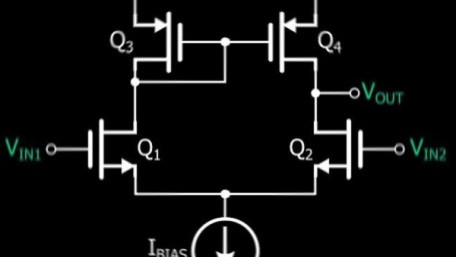
In this article, we’ll discuss two benefits of using an active load: improved biasing conditions and differential-to-single-ended conversion.
In this article, we’ll discuss two benefits of using an active load: improved biasing conditions and differential-to-single-ended conversion.

Learn about a fairly simple yet highly beneficial modification to the drain-resistor-based version of the MOSFET…
Learn about a fairly simple yet highly beneficial modification to the drain-resistor-based version of the MOSFET differential pair.

Learn how to use an Arduino in combination with an LCD display and a keypad to make a calculator.
Learn how to use an Arduino in combination with an LCD display and a keypad to make a calculator.

In this article, we’ll examine the most straightforward version of this foundational integrated-circuit amplifier topology.
In this article, we’ll examine the most straightforward version of this foundational integrated-circuit amplifier topology.

Learn about a straightforward version of a circuit that is essential in the design of analog integrated circuits.
Learn about a straightforward version of a circuit that is essential in the design of analog integrated circuits.

This article describes the bridge-amplifier configuration and explains why it’s especially handy when you don’t have…
This article describes the bridge-amplifier configuration and explains why it’s especially handy when you don’t have a negative voltage supply.

This article presents some basic cap-sense circuit configurations and discusses how to deal with low- and high-frequency noise.
This article presents some basic cap-sense circuit configurations and discusses how to deal with low- and high-frequency noise.

Combine the Si4844-A10 analog-tuned radio receiver with an Arduino to make a full-featured multiband radio.
Combine the Si4844-A10 analog-tuned radio receiver with an Arduino to make a full-featured multiband radio.

In this article, we’ll compare active and passive filters and look at some common second-order active topologies.
In this article, we’ll compare active and passive filters and look at some common second-order active topologies.

Internal or external? Quartz or ceramic? Crystal oscillator or silicon oscillator? So many clocking options . . . which…
Internal or external? Quartz or ceramic? Crystal oscillator or silicon oscillator? So many clocking options . . . which one is right for your design?

This project will show you how to connect an ultrasonic sensor and an Arduino to turn on a light when motion is sensed.
This project will show you how to connect an ultrasonic sensor and an Arduino to turn on a light when motion is sensed.

In this article, we'll review the basic concepts in digital filter design. We'll also briefly discuss the advantages of…
In this article, we'll review the basic concepts in digital filter design. We'll also briefly discuss the advantages of FIR filters over IIR designs, e.g. stability and linear-phase response. Finally, we'll go over an introduction to designing FIR filters via the window method.

Part Three in this three-article series shows you how to generate values for a discrete sinusoid and continuously convert…
Part Three in this three-article series shows you how to generate values for a discrete sinusoid and continuously convert this data into an analog signal without overburdening the CPU.

In this article, we will discuss some characteristics of the ideal diode. We'll also learn how to analyze circuits that…
In this article, we will discuss some characteristics of the ideal diode. We'll also learn how to analyze circuits that contain more than one ideal diode in conjunction with resistors and DC power sources.

Part Two in this three-article series explores the SAM4S DAC. We’ll look at hardware configuration, electrical…
Part Two in this three-article series explores the SAM4S DAC. We’ll look at hardware configuration, electrical characteristics, and the application programming interface.

Part One in this three-article series focuses on using the SAM4S timer/counter peripheral to precisely control the…
Part One in this three-article series focuses on using the SAM4S timer/counter peripheral to precisely control the DAC’s sampling rate.

Classifying signals is a way to organize the signals that surround us. It focuses design, testing requirements,…
Classifying signals is a way to organize the signals that surround us. It focuses design, testing requirements, measurement tools, and expected results. There are many ways to classify signals!

Build a generator-powered LED headlight for a longboard for very cheap.
Build a generator-powered LED headlight for a longboard for very cheap.

In this article we’ll use the SAM4S Xplained Pro development platform to get some hands-on experience with a PWM DAC.
In this article we’ll use the SAM4S Xplained Pro development platform to get some hands-on experience with a PWM DAC.

Learn LabVIEW FPGA by programming the on-board Xilinx FPGA of the student-focused embedded device NI myRIO.
Learn LabVIEW FPGA by programming the on-board Xilinx FPGA of the student-focused embedded device NI myRIO.


 Facebook
 Google
 GitHub
 Linkedin
