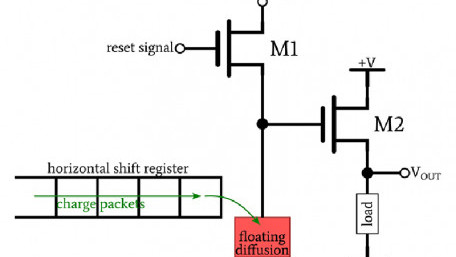
This article discusses charge-amplification techniques and explains the characteristics of the voltage waveform that contains a CCD’s pixel data.
This article discusses charge-amplification techniques and explains the characteristics of the voltage waveform that contains a CCD’s pixel data.

In this article, we’ll examine two important specifications of a digital oscilloscope: analog bandwidth and sampling rate.
In this article, we’ll examine two important specifications of a digital oscilloscope: analog bandwidth and sampling rate.

This article, the first in a series, discusses light-sensitive electronic devices called photodiodes and compares CCD and…
This article, the first in a series, discusses light-sensitive electronic devices called photodiodes and compares CCD and CMOS sensors.

In this article, we’ll set up a basic SiC switching circuit and perform some transient simulations.
In this article, we’ll set up a basic SiC switching circuit and perform some transient simulations.

This article reviews the silicon carbide scene and then explains how to get SiC SPICE models and incorporate them into a…
This article reviews the silicon carbide scene and then explains how to get SiC SPICE models and incorporate them into a simulation circuit.

This article explores an important limitation that can cause a real-life op-amp to deviate from the behavior of its…
This article explores an important limitation that can cause a real-life op-amp to deviate from the behavior of its idealized counterpart.

This is the final part of a six-article series on composite amplifiers. In this last part, we'll show how to improve…
This is the final part of a six-article series on composite amplifiers. In this last part, we'll show how to improve phase accuracy.

In Part 5 of this series on composite amplifiers, we'll discuss how to achieve higher DC precision.
In Part 5 of this series on composite amplifiers, we'll discuss how to achieve higher DC precision.

Learn how to get faster composite op-amp dynamics by raising the slew rate.
Learn how to get faster composite op-amp dynamics by raising the slew rate.

This is Part 3 of the series of articles about composite amplifiers. In this section, we are going to show how to achieve…
This is Part 3 of the series of articles about composite amplifiers. In this section, we are going to show how to achieve faster op-amp dynamics by expanding the frequency bandwidth.

Learn how simulating a voltage buffer can help you implement it more effectively to boost the output current drive of an op-amp.
Learn how simulating a voltage buffer can help you implement it more effectively to boost the output current drive of an op-amp.

In the first part of this series on composite amplifiers, we'll investigate one method of boosting an op-amp’s output…
In the first part of this series on composite amplifiers, we'll investigate one method of boosting an op-amp’s output current drive capability.

This article presents three analysis methods in which a diode is modeled using an exponential current–voltage…
This article presents three analysis methods in which a diode is modeled using an exponential current–voltage relationship or a threshold-based linear relationship.

This article explains two methods that we use to evaluate the currents and voltages that are present in a circuit that…
This article explains two methods that we use to evaluate the currents and voltages that are present in a circuit that includes one or more diodes.

This article provides foundational information on the electrical behavior of forward-biased diodes.
This article provides foundational information on the electrical behavior of forward-biased diodes.

In this article, we’ll take a look at the analog blocks for implementing the square wave-based synchronous demodulator.
In this article, we’ll take a look at the analog blocks for implementing the square wave-based synchronous demodulator.

Learn about how power spectral density (PSD) helps us to examine the effect of a noise source on the output of a linear…
Learn about how power spectral density (PSD) helps us to examine the effect of a noise source on the output of a linear time-invariant (LTI) system.

This article is the fourth of a series on microcontroller timers which discusses internal watchdogs.
This article is the fourth of a series on microcontroller timers which discusses internal watchdogs.

This article is the third of a series on microcontroller timers which describes the RTCs inside a microcontroller.
This article is the third of a series on microcontroller timers which describes the RTCs inside a microcontroller.

In this article, we’ll look at the pros and cons of using a switch-based multiplier.
In this article, we’ll look at the pros and cons of using a switch-based multiplier.


 Facebook
 Google
 GitHub
 Linkedin
